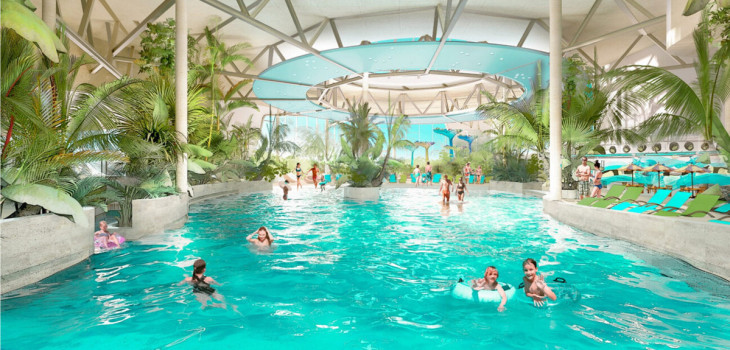
Germany has around 6,000 public swimming pools, approximately half of which are believed to require refurbishment. Faced with an investment backlog running into billions of euros, parts of the industry joined forces in 2026 to draw the attention of policymakers and the public to the situation. At the same time, local authorities across the country are investing in ambitious new-build projects combining sport, leisure, wellness and energy efficiency. This two-tier market, caught between urgent refurbishment needs and innovative flagship projects, is also a key focus of discussions at interbad, which is taking place in Stuttgart from 6 to 8 October 2026.
Germany: Between a funding crisis and a new generation of swimming pools - a market in transition
An industry sounds the alarm
It is the defining issue of 2026 in Germany: Bäderallianz Deutschland, an alliance bringing together sports federations, pool operators and industry organisations, has launched a nationwide poster campaign under the banner "Retten wir die Bäder!" ("Save Our Swimming Pools!"), which officially began on 27 May 2026. Its aim is to draw the attention of the public and policymakers to the condition of Germany's public swimming pool infrastructure, which some industry representatives have described as "catastrophic". The alliance is calling for investment of around EUR1 billion per year over a twelve-year period, to be allocated to the refurbishment of existing facilities, energy-efficiency upgrades and new construction.
The campaign also highlights a tangible public health and social concern: according to the figures it has published, a growing number of children in Germany are unable to swim safely because they do not have sufficient access to swimming pools during their school years.
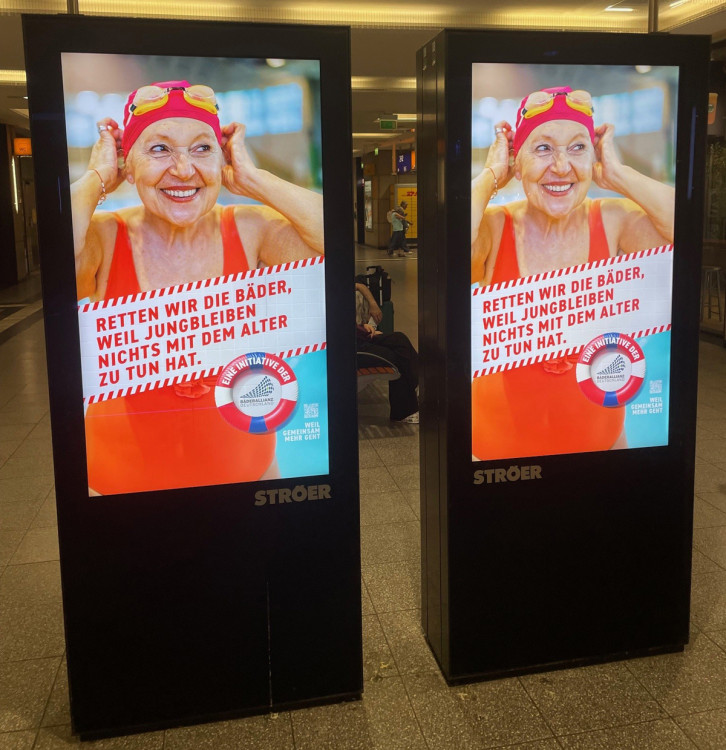
The nationwide "Retten wir die Bäder!" campaign launched by Bäderallianz Deutschland
Projects leading the way
While the funding crisis dominates public debate, several local authorities are nevertheless pressing ahead with new-build projects, often designed as showcases for energy-efficient pool operation.
In Frankfurt, the future Rebstockbad is a prime example of this approach. Following the demolition of the former facility in 2022, construction work began in March 2024, with completion scheduled for 2027. The complex will feature a competition-standard 50-metre swimming area, a learner pool, a diving area and a leisure zone with a lazy river, warm-water pools and a range of water slides. It will also include its own "sauna world", with an extensive outdoor sauna area. More than 2,000 m² of solar panels, geothermal boreholes and connection to a district heating network incorporating combined heat and power are intended to enable energy-efficient operation.
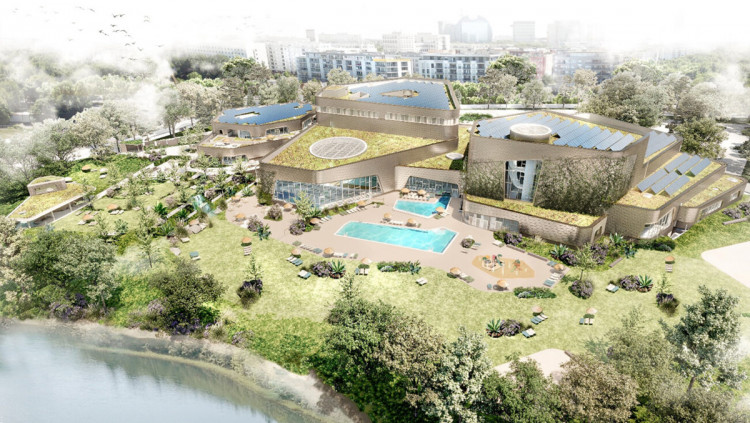
The future Rebstockbad in Frankfurt has been designed as a sustainable public facility combining sports and leisure pools, a sauna complex and extensive outdoor areas © Geising + Böker
In Oppenheim, Rhineland-Palatinate, the new indoor pool planned by the Rhein-Selz collective municipality is being presented as a "flagship project". It is expected to be the first indoor swimming pool in Germany to combine photovoltaic panels on both its roof and façade, electrolysis to convert surplus electricity into storable hydrogen, and geothermal heat pumps. The aim is to achieve completely carbon-neutral operation. Construction began in late August 2025. The facility will include a six-lane, 25-metre pool, one- and three-metre diving boards, a learner pool and a paddling pool.
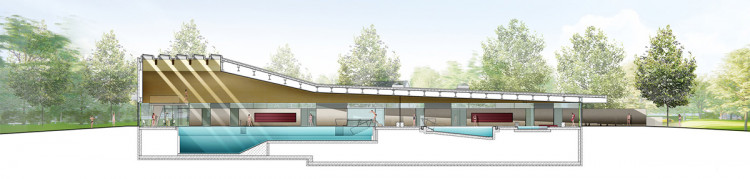
Oppenheim Indoor Swimming Pool / Germany © B1 Design - VenhoevenCS & MOW
In Dachau, Bavaria, a new swimming pool complex is due to open in autumn 2026. The project represents an investment of around EUR35 million, plus a contingency reserve of EUR1 million. Developed around the theme "A Walk to the River", the concept combines nature-inspired design with an aquatic play area for young children, water slides, a diving tower and a wellness pool.
Three projects of different sizes, but all conveying the same message: when German local authorities invest in swimming pools today, energy efficiency and multifunctional use are almost invariably central to their plans.
The Kombibad - a typically German concept
These projects illustrate a concept firmly rooted in German bathing culture: the Kombibad. The Duden dictionary defines it as a public swimming facility combining an indoor and an outdoor pool on the same site. Visitors can therefore swim indoors in winter and outdoors in summer.
The concept very often includes a sauna area and has become standard in many of Germany's new, larger public swimming facilities. Sharing infrastructure makes it possible to optimise operating costs and maximise attendance throughout the year - a significant advantage at a time when local authority budgets are under pressure.
Artificial intelligence at the poolside
Germany is also breaking new ground in the use of AI-assisted safety solutions. Since January 2025, the Stadionbad in Cologne, operated by KölnBäder GmbH, has been equipped with the Lynxight system. Eight cameras positioned around the sports and learner pools analyse swimmers' movements in real time and can detect an emergency in under 30 seconds. Lifeguards are then alerted via smartwatch.
The installation cost around EUR50,000. The operator stresses that the technology complements human supervision rather than replacing it - a point that is particularly relevant to the debate in France over the shortage of qualified lifeguards.
interbad and the DGfdB Congress address the industry's current challenges
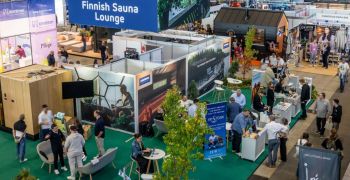
These issues are at the heart of interbad, held alongside the 71st Congress of the DGfdB, the German Association for the Recreational and Medicinal Bath Industry. The key themes of this edition directly reflect the challenges currently facing the sector: digitalisation and the development of smart facilities, decarbonisation of energy supplies, multifunctional sites, mental health, urban resilience, municipal pool management, and the further development of the wellness and physiotherapy sectors.
Natural swimming pools: another regional feature
No discussion of public swimming facilities in Germany would be complete without mentioning its Naturschwimmbäder, or natural swimming pools. This bathing culture is particularly well established in Bavaria, Baden-Württemberg and Schleswig-Holstein.
These facilities use plant-based and mineral filtration systems and operate without chemical water treatment. They represent an increasingly popular alternative for local authorities seeking to strengthen their environmental credentials, adding a model to Germany's public swimming pool landscape that combines ecological objectives with public recreational use.